Baby and Newborn Passport Photo Rules, Quoted From the US and UK Sources
Eyes closed, a tilted head and a lie-down shot are all explicitly allowed for infants — but the US and the UK relax different rules. The exact wording from 8 FAM 402.1 and GOV.UK, and the safe overlap between them.
Baby passport photos are the one case where the rules genuinely bend. Every guide tells you a passport photo needs open eyes, a neutral expression and a straight head — and then you try to photograph a three-week-old and discover that none of that is going to happen.
The good news is that the authorities already know. Both the US and the UK publish explicit infant exceptions. The bad news is that the two countries relax different rules, and the thing one allows is sometimes the thing the other rejects. Here is what each actually says, quoted rather than paraphrased.
The United States: "the best likeness that can reasonably be obtained"
The State Department's internal guidance for passport staff is public, and it is far more useful than the summary page. Section 8 FAM 402.1-2 says infants "pose a particular challenge. The goal is the best likeness that can reasonably be obtained", and then lists three concessions:
- "It is acceptable if the infant's eyes, particularly a newborn's, are partially or completely closed"
- "The infant's head may be discreetly supported, e.g., a car seat with a white or off-white blanket behind the child. Head tilt is acceptable for infants"
- "A parent's face cannot be in the photograph of the infant"
Two of those are worth reading twice. Head tilt is acceptable — the tipped-over newborn head that looks wrong in every other passport photo is explicitly fine. And the rule about parents is written about the face, with a car seat given as the example of acceptable support.
The United Kingdom: the exceptions are keyed to age
GOV.UK splits its concessions by age, which is unusually precise:
- "Children under 6 do not have to be looking directly at the camera or have a plain expression"
- "Children under one do not have to have their eyes open"
- "Children under one should lie on a plain light-coloured sheet. Take the photo from above"
- "You can support their head with your hand, but your hand must not be visible in the photo"
- "Children must be on their own in the picture"
- "Babies must not be holding toys or using dummies"
So the UK openly sanctions the lie-down-and-shoot-from-above method, and openly permits your hand behind the child's head so long as the camera cannot see it. That is a more forgiving position than most parents expect.
The difference that catches people out
Read the two side by side and the divergence is in what is banned from the frame. The UK bans a visible hand and says the child must be alone. The US text bans a parent's face and offers a car seat as the worked example of support.
In practice the safe intersection is simple, and it satisfies both: lay the baby on a plain white or off-white sheet, or in a car seat draped with one, shoot from directly above or straight on, and keep every part of yourself — hands included — outside the frame. That way you are not relying on either country's more generous clause.
How big the head has to be, and why hair is excluded
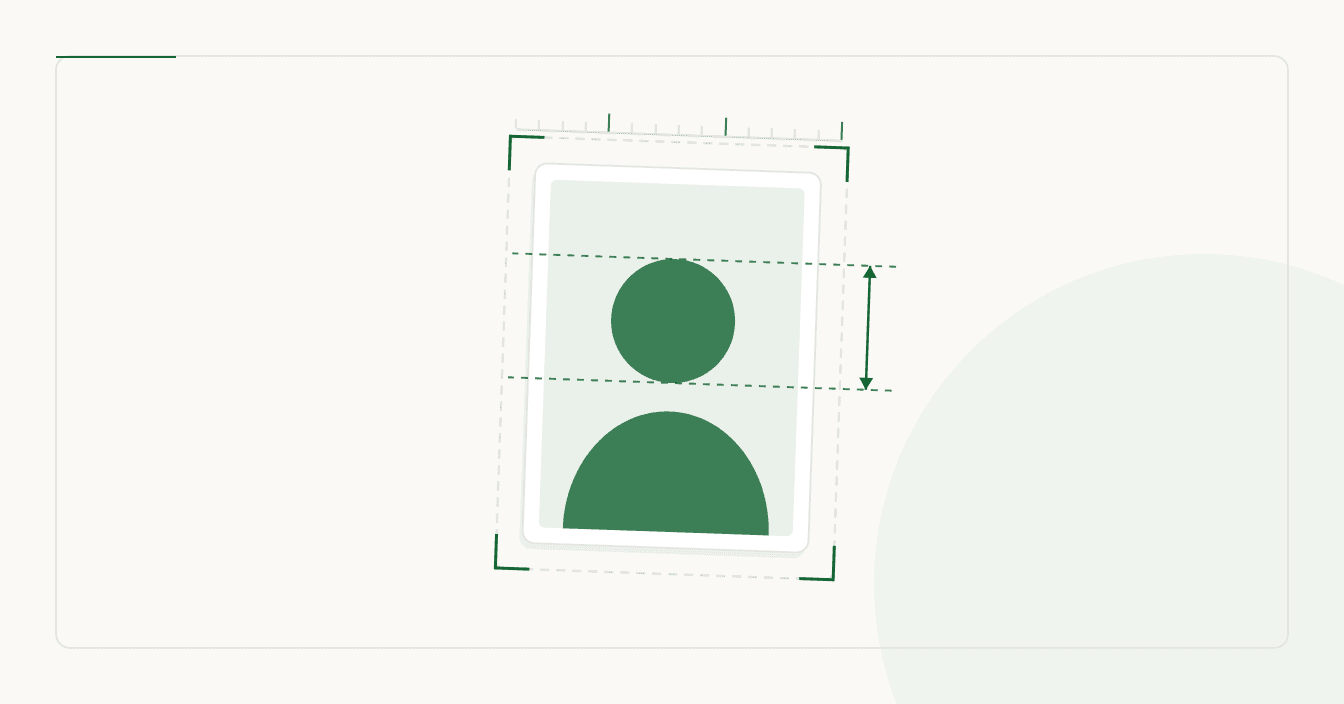
The US measurement is where infant photos quietly fail. The manual asks for a facial image "no less than 1" (about 2.54 cm.) and no more than 1 3/8" (about 3.5 cm.), measured from the top of the head (not the hairline or the applicant's hair) to the bottom of the chin".
Note the parenthesis: the measurement is to the top of the head, not to the top of the hair. Newborn hair is wispy, sticks up, and photographs as a halo. It does not count toward the 25–35 mm window, so measuring to the tip of it will make you crop the photo too tight. The same section adds that "the ears do not have to be visible", which removes another thing parents worry about.
The US print size is 2 x 2 inches, "about 5 cm. x 5 cm." — that is our 2x2 inch passport photo tool. The UK and most of Europe use 35 x 45 mm, which is this one.
How recent the photo has to be
The US asks for a photo "taken within six months of submitting the application". The UK is much tighter: "Your photo must have been taken in the last month."
For an adult this is a formality. For a baby it is the whole problem, because a six-month-old and a newborn are not recognisably the same child. Take the photo close to when you actually apply, not when you first think of it.
If you are applying online in the UK, do not crop
This one reverses the usual advice. The UK digital service says to "include your head, shoulders and upper body. Do not crop your photo - it will be done for you." The file itself needs to be at least 600 pixels wide and 750 tall, and "at least 50KB and no more than 10MB".
So for a UK online application you want a full, uncropped shot that clears 50 KB — a bar a phone photo passes easily. If your image is over 10 MB, shrinking it is the only step needed. Cropping it to 35 x 45 mm yourself is for a printed application, not the online one.
What not to do, in any country
Do not edit the photo beyond a plain crop and resize. No background replacement, no smoothing, no removing a stray hand in software, no AI "passport photo" generator. Photo checks flag edited images, and a fixed background is one of the easier things to detect. If the sheet came out creased, re-shoot it — that is genuinely faster than arguing with an examiner later.
We will not tell you a photo is guaranteed to be accepted; nobody outside the passport office can. Our photo checker measures dimensions, file weight, background evenness and sharpness in your browser, and it is honest about its limits — the head-size figure is an estimate derived from the outline, and for an infant photographed from above against a sheet it will often report that it could not judge rather than invent a number.
A short checklist
- Plain white or off-white sheet, no pattern, no shadows.
- Baby alone in the frame. No hands, no toys, no dummy.
- Eyes closed is fine under one. Tilted head is fine in the US.
- Natural indirect light, not flash, and not directly under a ceiling lamp.
- Take thirty and pick one. This is the one photo where volume genuinely helps.
More from the blog
- How to Crop a Photo to 2x2 Inches (and Why the Square Is the Easy Part)
- WhatsApp profile picture size: the square you upload and the circle everyone sees
- What size photo for Instagram: the ratios Meta actually publishes
- What DPI for printing? Photos, posters, stickers, T-shirts and Procreate, with the pixel counts that actually matter